California Association of Social Rehabilitation Agencies
Newsletter | December 4, 2025
Highlights and Spotlights

Welcome to the CASRA Newsletter

In this issue:

-Homeless camp sweeps can harm health

-Report questions why police mental health specialists must defer to armed officers

-Homelessness is a public health emergency

-How "micro joy" can help you feel better

Enjoy!


If you have news you would like to share or a colleague you would like to spotlight because of the great work they do or just because they are a great person or both, let us know by contacting joe@casra.org.

Photo Gallery

A new feature has been added to the CASRA website for your viewing plasure. A Photo Gallery now resides on the EVENTS page and currently consists of albums of the 2024 Spring and the 2025 Fall CASRA Gatherings. We plan on adding more albums in the future.

If you have photos of your agency's events you would like to share with other CASRA members, contact joe@casra.org.

To view the current albums in the Photo Gallery, CLICK HERE.

CASRA Learning Library

We are excited to announce that the CASRA Learning Library is now operational!

The Learning Library and its contents are free to CASRA member organizations and their staff. The Library is located in the Member Portal on the CASRA website here. More detailed instructions on how to access and use the Library can also be found on the CASRA website when logged on the Portal.

Our hope is that the Library's offerings will provide learning opportunities that will serve as part of CASRA agencies' onboarding processes for new staff, as well as be a resource of Recovery oriented values and practices for all staff. 

Access to the Learning Library is currently limited to CASRA member agencies and their staff. We hope to expand availability in the future.

For questions and more information contact Joe Ruiz - joe@casra.org.

CASRA Member Agency Employment Opportunities and Information

Our member agencies are continually looking for new employees or volunteers to join their workforce.

To see current openings and find out additional information about CASRA Member Agencies, please click below.

CASRA Member Agency Learning Opportunities

A benefit of membership in CASRA is receiving four hours of training for your staff. For more information, please contact joe@casra.org


If you are a CASRA member agency and would like to advertise your learning opportunity, training or event for the benefit of other CASRA member agencies, please contact us at events@casra.org.
There are a few guidelines:
-You are a CASRA Member Agency
-Your event is free of charge
and, as a reminder the Newsletter is published on the 1st and 3rd Thursdays of the month

CASRA Member Agency Support Groups

CASRA facilitates a number of support groups for people working at CASRA member agencies. The support groups provide people working in similar roles opportunities to share experiences, information, and challenges. They meet monthly for approximantely one hour. for more information contact the person listed for each group.

Social Rehabilitation Facilities (SRF)
Meets: First Tuesday of the month at 1 PM

Human Resources
Meets: First Thursday of the month at 11 AM

Employment/Vocational Rehabilitation Services
Meets: First Thursday of the month at 3 PM

For information regarding any of the above groups contact:
Chad Costello, chad@casra.org

Wellness Services (Well Talk)
The Wellness Services support group is now online. For more info contact Joe Ruiz, joe@casra.org

Who We Are

CASRA is a statewide organization of private, not-for-profit, public benefit corporations that serve clients of the California public mental health system.

Member agencies provide a variety of services that are designed to enhance the quality of life and community participation of youth, adults and older adults living with challenging mental health issues. Read more

Contact Us

The California Association of Social Rehabilitation Agencies

Mailing Address:
3350 E. 7th Street, #509
Long Beach, CA 90804

Email: casra@casra.org

Phone: (562) 343-2621

To reach us: use our Contact Form
Advocacy/Policy/News

Homeless Camp Sweeps Can Harm Health. Some Cities Are Trying a New Way

Several cities and counties are addressing street homelessness with a new approach, which experts say can clear encampments while protecting the health of people who are forced to move.

From mindsitenews.org
By Ryan Levi, November 24, 2025

Jazmine Mapes has spent most of her life on the move.

When she was a young child, she shuttled from city to city in Southern California as her parents broke up and got back together. Her dad was abusive, Mapes said, and around age 9, she and her younger brother started bouncing around the foster care system.

Now 31, Mapes has spent much of her adult life homeless, living in riverbeds and tents on the sidewalk. She’s dealt with regular “sweeps” — police officers and other city workers ordering her to leave so they can clear the area.
Mapes has lost clothes, sleeping bags and — perhaps most importantly — medications for her anxiety and depression. One cleanup crew threw away a photo album filled with pictures of the four children she gave up for adoption.

After a sweep, “I would just stay in my depression,” Mapes said. “I would stay getting high because getting high was a way of me coping. Me not feeling.” Read More


Report questions why LAPD mental health specialists must defer to armed officers

From latimes.com
By Libor Jany, October 29, 2025

A new report from the city controller’s office questions the effectiveness of the LAPD’s signature crisis response program, saying clinicians trained in de-escalation too often are forced to defer to armed patrol officers.

For years, Los Angeles Police Department officials have touted the success of the Systemwide Mental Assessment Response Team, or SMART. But critics say the program, which pairs licensed specialists with officers in unmarked cars, is failing in the crucial initial minutes of encounters when multiple police shootings of mentally ill people have occurred.

Dinah M. Manning, chief of strategic initiatives and senior advisor in the controller’s office, said the report found an “inherent contradiction” in the SMART program. Read More


Homelessness Is a Public Health Emergency, Not a PR Problem

From sfchronicle.com
By Claire Schutz, November16, 2025

in permanent housing and care, we pour money into short-term “clean-up” efforts that push people from one block to the next. San Francisco has spent millions on sweeps that displace residents without addressing why they’re there in the first place: the cost of living, untreated mental illness, substance use and a thin social safety net that leaves people one paycheck, or one health crisis, away from the streets.

During his election campaign, Mayor Daniel Lurie promised to create 1,500 new shelter beds in six months, a lofty goal that generated headlines but quickly proved unrealistic. With only 400 beds created during his term thus far, short-term investments in temporary housing solutions prove to be futile.

When I volunteered at Suitcase Clinic, a student-run organization at UC Berkeley that provides care for homeless and low-income residents, I saw firsthand how fragile life becomes without stable housing. Patients showed up with untreated wounds, infections or dental abscesses because Medi-Cal providers couldn’t see them soon enough. Many simply wanted a safe place to rest. What they needed wasn’t another referral sheet, but stability. Every day, I pass tents tucked under freeway ramps, behind grocery stores and next to gleaming biotech campuses. In the Bay Area, these scenes have become so routine that we barely look twice. Read More


How “Micro Joy” Can Help You Feel Happier Everyday

Sometimes the smallest steps can make a big difference

From fastcompany.com
By Tracy Brower, November 20, 2025

In a world of hustle culture and stressors of all kinds, joy can seem both illusive and impossible. But despite barriers, you can create the conditions for happiness.

Well-being and joy are critical issues today, with 69% to 77% of Americans feeling stressed about factors like the economy, current events, violence, and lack of connections, according to the American Psychiatric Association. In addition, a global mental health study of 17,000 people across 16 countries by Ipsos/AXA found that 64% face stress, 43% are suffering from depression, and only 25% of people are flourishing.

But strategies for “micro joy” can be a solution to the struggles and a way to build both well-being and resilience. Micro joy is made up of the small moments of happiness, presence, and mindfulness that we can find in the midst of challenge or difficulty. It is about embracing the power of little delights in the everyday.

How can you create micro joy in your life? Here’s what works best. Read More


If you or someone you know is considering suicide or self-harm, there are resources available to provide free and confidential support. Call 988 or the Teen Line at 1-800-TLC-TEEN or The Trevor Project at 1-866-488-7386 for LGBTQ young people.

Trainings/Conferences and other Learning Opportunities

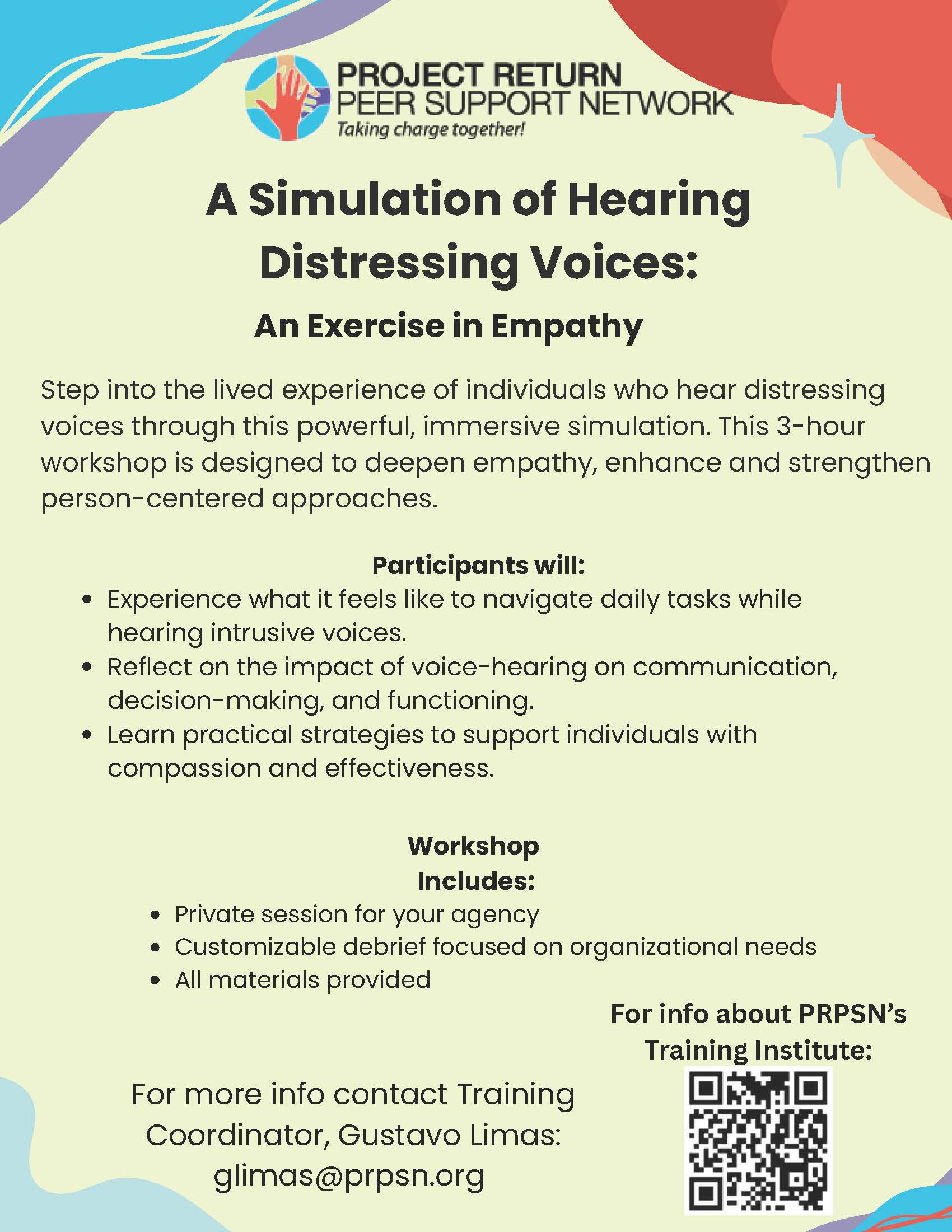
Project Return Peer Support Network (PRPSN) Earns WRAP Center of Distinction Certification

CASRA member agency Project Return Peer Support Network (PRPSN) is now a licensed WRAP Provider and affiliate of Advocates for Human Potential and has been officially recognized as a WRAP Center of Distinction.

This prestigious designation highlights PRPSN’s commitment to excellence in delivering Wellness Recovery Action Plan (WRAP) Seminars and supporting recovery-oriented practices. PRPSN's Training Institute is now a leading provider of WRAP Seminars across the West Coast, helping individuals and organizations build wellness tools that foster hope, personal responsibility, and empowerment.

For more information or to schedule a WRAP Seminar, please contact PRPSN's Training Coordinator, Gustavo Limas at glimas@prpsn.org.


Final Thoughts

Truth is ever to be found in simplicity, and not in the multiplicity and confusion of things.

Issac Newton


Previous | Next