California Association of Social Rehabilitation Agencies
Newsletter | May 7, 2026
Highlights and Spotlights

Welcome to the CASRA Newsletter

In this issue:

-Mental Health Funding Cuts could result in Butte County Programs to Close

-The Roots of Indegienous Homelessness Go Back Generations

-A Possible Breakthrough for an Innovative Type of Housing in CA?

-A Danish Program Takes on the Stigma of Mental Illness

Enjoy!


If you have news you would like to share or a colleague you would like to spotlight because of the great work they do or just because they are a great person or both, let us know by contacting joe@casra.org.

CASRA Member Agency Learning Opportunities

A benefit of membership in CASRA is receiving four hours of training for your staff. For more information, please contact joe@casra.org


If you are a CASRA member agency and would like to advertise your learning opportunity, training or event for the benefit of other CASRA member agencies, please contact us at events@casra.org.
There are a few guidelines:
-You are a CASRA Member Agency
-Your event is free of charge
and, as a reminder the Newsletter is published on the 1st and 3rd Thursdays of the month

Photo Gallery

A Photo Gallery now resides on the EVENTS page of the CASRA website and currently consists of albums of the 2024 Spring and the 2025 Fall CASRA Gatherings. We plan on adding more albums in the future.

If you have photos of your agency's events you would like to share with other CASRA members, contact joe@casra.org.

To view the current albums in the Photo Gallery, CLICK HERE.

CASRA Learning Library

The  CASRA Learning Library and its contents are free to CASRA member organizations and their staff. The Library is located in the Member Portal on the CASRA website here. More detailed instructions on how to access and use the Library can also be found on the CASRA website when logged on the Portal.

Our hope is that the Library's offerings will provide learning opportunities that will serve as part of CASRA agencies' onboarding processes for new staff, as well as be a resource of Recovery oriented values and practices for all staff. 

Access to the Learning Library is currently limited to CASRA member agencies and their staff. We hope to expand availability in the future.

For questions and more information contact Joe Ruiz - joe@casra.org.

CASRA Member Agency Employment Opportunities and Information

Our member agencies are continually looking for new employees or volunteers to join their workforce.

To see current openings and find out additional information about CASRA Member Agencies, please click below.

CASRA Member Agency Support Groups

CASRA facilitates a number of support groups for people working at CASRA member agencies. The support groups provide people working in similar roles opportunities to share experiences, information, and challenges. They meet monthly for approximantely one hour. for more information contact the person listed for each group.

Social Rehabilitation Facilities (SRF)
Meets: First Tuesday of the month at 1 PM

Human Resources
Meets: First Thursday of the month at 11 AM

Employment/Vocational Rehabilitation Services
Meets: First Thursday of the month at 3 PM

For information regarding any of the above groups contact:
Chad Costello, chad@casra.org

Wellness Services (Well Talk)
The Wellness Services support group is now online. For more info contact Joe Ruiz, joe@casra.org

Who We Are

CASRA is a statewide organization of private, not-for-profit, public benefit corporations that serve clients of the California public mental health system.

Member agencies provide a variety of services that are designed to enhance the quality of life and community participation of youth, adults and older adults living with challenging mental health issues. Read more

Contact Us

The California Association of Social Rehabilitation Agencies

Mailing Address:
3350 E. 7th Street, #509
Long Beach, CA 90804

Email: casra@casra.org

Phone: (562) 343-2621

To reach us: use our Contact Form
Advocacy/Policy/News

Mental Health Funding Shift Could Lead Butte County Mental Health Service Centers To Close Doors

From actionnewsnow.com
By Bella Barbosa, May 1, 2026

Mental health services in Butte County will soon change as California shifts from the Mental Health Services Act to the Behavioral Health Services Act.

Starting July 1, millions of dollars in state funding will be reallocated to a new category under behavioral health. Shifting the focus from community-based mental health programs to housing, drug abuse treatment, and early intervention services.
The change is a result of Proposition 1, which passed in 2024. Funding priorities will move away from some community-based mental health programs.

The Iverson Wellness and Recovery Center held what could be its last wellness fair on Friday, as the center is expected to close after losing its funding.

The fair brought together many local wellness services; seven of them will lose funding because of the change. Read More


The Roots of Indigenous Homelessness Go Back Generations

From Federal Policy to Funding Gaps, Native Communities Face a Crisis That Remains Largely Unseen and Unaddressed

From invisiblepeople.tv
By Jocelyn Figueroa, May 5, 2026

An Unseen and Uncounted Crisis

Before the COVID-19 pandemic, the Northern Circle Indian Housing Authority had no access to the federal Continuum of Care (CoC) funds available for homeless services, shelter, and housing. When the Northern Circle Indian Housing Authority began reaching out to local CoC funds in Mendocino County, CA, they found that their data on homeless counts were highly inaccurate. “And why? Because they weren’t going into the reservation, right?” McGill said.

Native people experience the second-highest rate of homelessness in the United States. Like homelessness everywhere, access to affordable housing is a primary cause. Compounding this issue is a myriad of other factors, but most importantly, the fact that 80% of Native people no longer live on reservations. Very little federal funding is directed specifically toward Native Americans, and the funds that do exist are intended for the reservations.

Historical trauma compounds these issues once again, causing a great mistrust of government assistance. With the limited funding available, few Native people access those resources. In fact, native people access shelters at the lowest rate compared to any other demographic. Read More


An Innovative Type of Housing Has Stalled in California for Decades. Is It Finally Ready To Break Through?

From sfchronicle.com
By Allison Arieff, April 26, 2026

It’s news to no one that California has a huge housing crisis due in large part to its lack of supply. State lawmakers moved aggressively in the past few years to remove the bureaucratic obstacles surrounding zoning, environmental review and approval timelines that hamper new development. Yet production has not meaningfully increased. Skyrocketing labor and construction costs have made many housing projects financially infeasible to build.

Now, lawmakers are promising to do something about it.

On March 24, a bipartisan coalition led by Assembly Member Buffy Wicks, D-Oakland, rolled out a six-bill “housing innovation package,” aimed explicitly at bringing down building costs. Read More


A Danish Program Takes On the Stigma of Mental Illness

One of Us, Run by Denmark’s Health Ministry, Works With People With Mental Health Conditions To Share Their Stories in Schools, Hospitals and Police Stations, Helping Turn Fear Into Understanding.

From nytimes.com
By Simar Bajaj, March 3, 2024

At a class reunion a few years ago, a former teacher asked Giuseppe Parlatore what he was doing these days. He was on a state disability pension, he said.

“Did you hurt yourself?” the teacher asked. When Mr. Parlatore said no, that he had a mental illness, paranoid schizophrenia, the teacher instinctively stepped back. “Oh, then you’re dangerous,” Mr. Parlatore remembered him saying.

The shame that immediately flooded Mr. Parlatore was familiar, he said. He wanted to protest that no, he wasn’t dangerous, but he knew the conversation was already over, his life reduced to a crude stereotype.

“I have this diagnosis, and I have my challenges,” Mr. Parlatore said. “But that doesn’t make me less of a person.” Read More


If you or someone you know is considering suicide or self-harm, there are resources available to provide free and confidential support. Call 988 or the Teen Line at 1-800-TLC-TEEN or The Trevor Project at 1-866-488-7386 for LGBTQ young people.

Trainings/Conferences and other Learning Opportunities

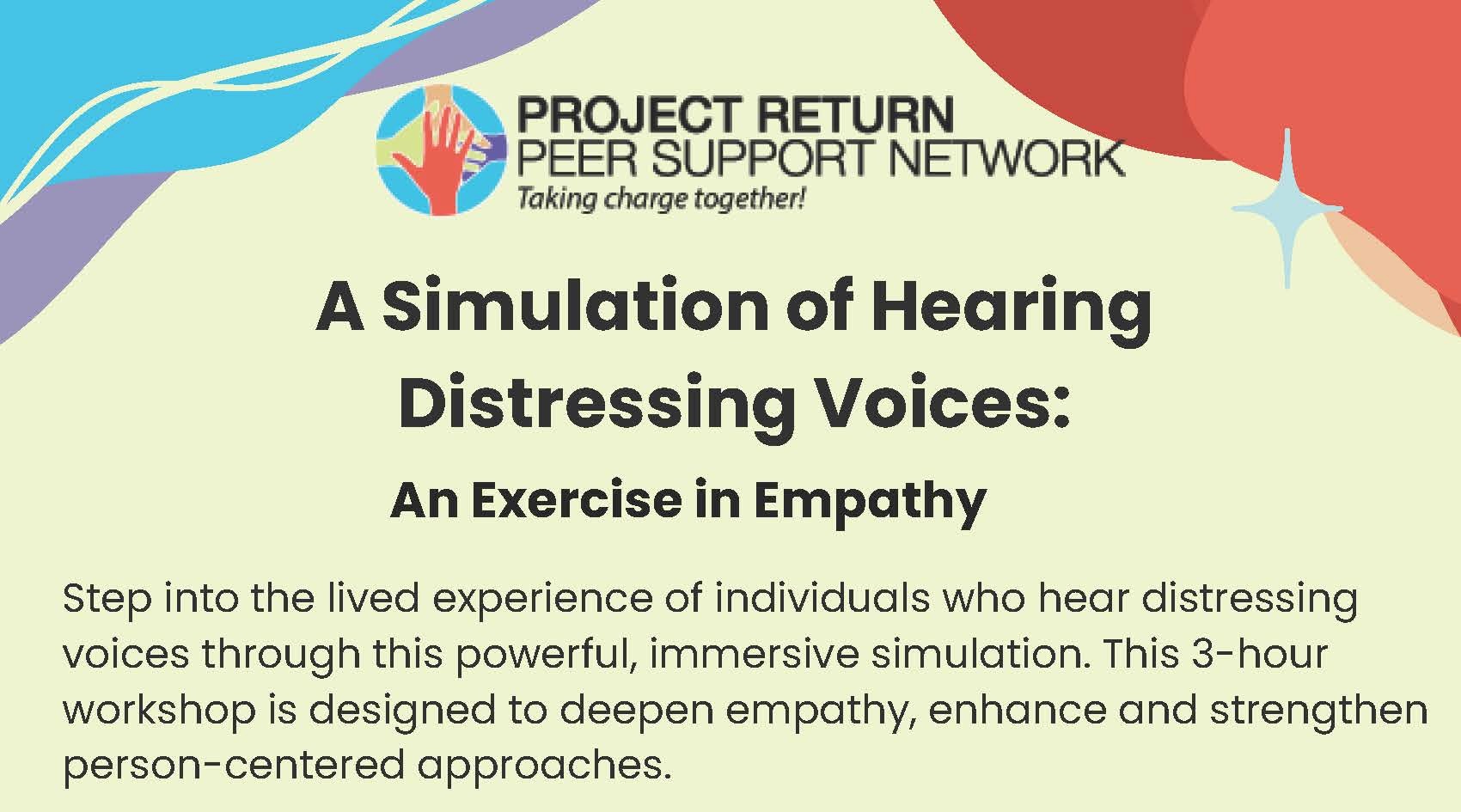
Project Return Peer Support Network (PRPSN) Provides certified WRAP training

CASRA member agency Project Return Peer Support Network (PRPSN) is now a licensed Wellness Recovery Action Plan (WRAP). PRPSN's Training Institute is now a leading provider of WRAP Seminars across the West Coast, helping individuals and organizations build wellness tools that foster hope, personal responsibility, and empowerment.

 For more information or to schedule a WRAP Seminar, please contact PRPSN's Training Coordinator, Gustavo Limas at glimas@prpsn.org.


Learn More

Final Thoughts

May is Mental Health Awareness Month

Sometimes the most important thing in a whole day is the rest we take between two deep breaths.

Etty Hillesum


Previous | Next