California Association of Social Rehabilitation Agencies
Newsletter | April 17, 2025
Highlights and Spotlights

Welcome to the CASRA Newsletter

In this issue:

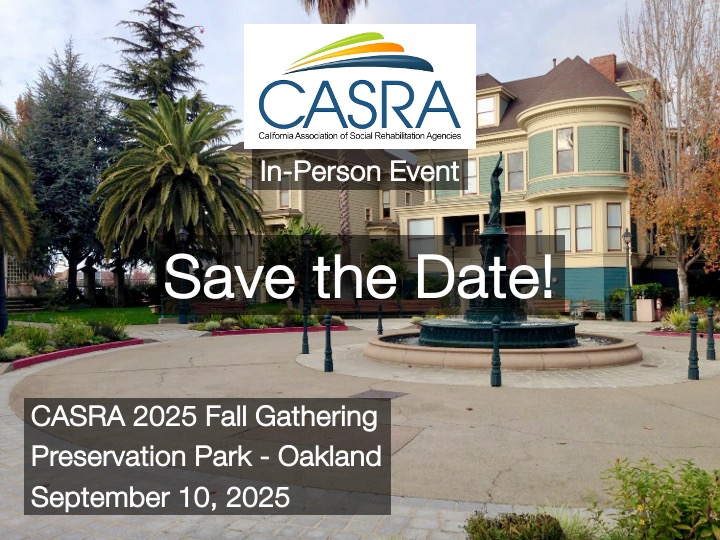
-Save the Date for the CASRA 2025 Fall Gathering 

-Voice hearers sharing stories without judgement

-Following a psychiatric nurse as she works the NYC Subway

-Is there a future for harm reduction in San Francisco?

-Where some workers have to live in New York City

-A webinar series for clairity, understanding and information regarding Payment Reform in California

Enjoy!


If you have news you would like to share or a colleague you would like to spotlight because of the great work they do or just because they are a great person or both, let us know by contacting joe@casra.org.

Who We Are

CASRA is a statewide organization of private, not-for-profit, public benefit corporations that serve clients of the California public mental health system.

Member agencies provide a variety of services that are designed to enhance the quality of life and community participation of youth, adults and older adults living with challenging mental health issues. Read more

Member Agency Employment Opportunities and Information

Our member agencies are continually looking for new employees or volunteers to join their workforce.

To see current openings and find out additional information about CASRA Member Agencies, please click below.

CASRA Agency Learning Opportunities

A benefit of membership in CASRA is receiving four hours of training for your staff. For more information, please contact joe@casra.org


If you are a CASRA member agency and would like to advertise your learning opportunity, training or event for the benefit of other CASRA member agencies, please contact us at events@casra.org.
There are a few guidelines:
-You are a CASRA Member Agency
-Your event is free of charge
and, as a reminder the Newsletter is published on the 1st and 3rd Thursdays of the month

CASRA Member Agency Support Groups

CASRA facilitates a number of support groups for people working at CASRA member agencies. The support groups provide people working in similar roles opportunities to share experiences, information, and challenges. They meet monthly for approximantely one hour. for more information contact the person listed for each group.

Social Rehabilitation Facilities (SRF)
Meets: First Tuesday of the month at 1 PM

Human Resources
Meets: First Thursday of the month at 11 AM

EmploymentVocational Rehabilitation Services
Meets: First Thursday of the month at 3 PM

For information regarding any of the above groups contact:
Chad Costello, chad@casra.org

Wellness Services (Well Talk)
The Wellness Services support group is now online. For more info contact Joe Ruiz, joe@casra.org

Contact Us

The California Association of Social Rehabilitation Agencies

Mailing Address:
3350 E. 7th Street, #509
Long Beach, CA 90804

Email: casra@casra.org

Phone: (562) 343-2621

To reach us: use our Contact Form
Advocacy/Policy/News


What Happens When Voice-Hearers Share Stories Without Judgment

Peer-Led Hearing Voices Groups Offer a Rare Space for Meaning-Making and Mutual Understanding Outside the Biomedical Model

From madinamerica.com
by Ally Riddle, April 8, 2025

A new research study published in the Community Mental Health Journal explores how Hearing Voices Groups (HVGs) provide a supportive environment for voice-hearers to develop shared meaning-making and dynamic causal models for their experiences.

Despite strong evidence that these peer-led, non-judgmental spaces support healing and meaning-making, HVGs remain underfunded and largely excluded from mainstream mental health services.

Voice-hearers often have diverse, evolving explanations for their experiences, shaped by culture and life history, which may contradict the biomedical explanations endorsed by healthcare professionals. These differing interpretations can have a significant impact on outcomes. Read More]


The Nurse in the NYC Subway

As Subway Assaults Rise and Calls for Safety Increase, a Psychiatric Nurse Must Decide Who Is a Risk

From washingtonpost.com
By Ruby Cramer, April 12 2025

The first thing Lisa Singh saw that worried her was the way the woman on the subway platform waved her off. The dismissiveness. Sometimes that was a sign of something. Lisa, a 53-year-old psychiatric nurse, took a step closer and scanned the woman’s face, searching for answers about what kind of care she might need.

The woman was slumped over on a bench at the 34th Street-Herald Square station, one subway stop in a city where the mayor, the governor and now the president were all demanding a more forceful approach to the type of person Lisa was beginning to assess. She and the rest of her team, five police officers and two homeless-outreach workers, huddled around the bench. Lisa saw swelling near the woman’s left eye and a bump on her head. She took out her phone and began taking notes: soiled clothing, malodorous, several large tote bags, a container of raw rice that had spilled onto the platform.

“Hi, I’m Lisa. I’m a nurse,” was how she usually began her clinical assessments, but the woman on the bench wasn’t speaking English. “I will just wait a little, and I will go,” she said in Cantonese, as the team’s NYPD supervisor, Capt. Hanjie Lu, began to translate.Read More


Does Harm Reduction Still Have a Future in San Francisco?

From sfchronicle.com
By Keith Humphreys, March 31, 2025

As Mayor Daniel Lurie’s administration calls for ending the distribution of fentanyl smoking supplies on city sidewalks, some are asking if harm reduction strategies should continue to play a part in San Francisco’s response to drug addiction.

They definitely should, as long as some critical realities are borne in mind.

First, harm reduction is a total population health strategy, meaning it is supposed to ensure that everyone’s well-being counts. Because drug addiction is a deeply stigmatized condition, in many places I visit, I have to remind people that “everyone” includes people who use drugs and that their lives and health have value. Read More


When They Go Home After Working All Day, It’s Not to a Home

Thousands of Working People in New York City Now Live In Shelters, Unable To Afford Apartments Despite Holding Down Jobs That Pay Them $50,000 or More

From nytimes.com

By Eliza Shapiro, April 8, 2025

By four in the morning, the young woman has already signed out of the Blue Sky Residence, the Queens homeless shelter where she lives, and started her commute to work. The local bus doesn’t run this early, so she sets out on foot, walking along the highway. She arrives at LaGuardia Airport before the first flight of the morning departs. For $22 an hour, she will spend her day directing travelers to their gates.

Around the same time, one of her neighbors at Blue Sky is resting her feet in a Target break room, nearing the end of her overnight shift preparing the store for its 8 a.m. opening. She makes $19 an hour, $20 for every hour she works after midnight.

And as the sun begins to rise, Kuber Sancho-Persad, who lives a few doors down, is napping in his taxi in the Kennedy Airport parking lot, waiting for the first passengers of the day to arrive with the early morning flights.

Their routines, quiet and mundane, signal a growing — and largely invisible — crisis that threatens New York City’s future. Read More


If you or someone you know is considering suicide or self-harm, there are resources available to provide free and confidential support. Call 988 or the Teen Line at 1-800-TLC-TEEN or The Trevor Project at 1-866-488-7386 for LGBTQ young people.

Trainings/Conferences and other Learning Opportunities

The Catalyst Center, in collaboration with DHCS, is hosting a series of Payment Reform Trainings designed specifically for county behavioral health departments and Medi-Cal providers. These trainings are a must-attend for anyone involved in implementing Payment Reform.

Why Attend?
-Gain clarity on Payment Reform goals and implementation strategies.
-Learn how to maximize reimbursement and streamline workflows.
-Engage in Q&A sessions with industry experts and peers.
-Ensure your organization is prepared for the changes ahead.

Training Schedule: Click on title to register
April 24, 2-4PM: Quality Assurance and Billing Best Practices – Learn how to streamline workflows, manage claims, and ensure financial sustainability.
May 22, 2-4PM: Managing for Success – Explore strategies for fiscal sustainability, telehealth integration, and aligning with DHCS’ CalAIM goals.
June 26, 12-2PM: A Summary and Discussion – Wrap up the series with a comprehensive review, key takeaways, and an extensive Q&A session.

Download the Webinar Series Flyer

Final Thoughts

"People seldom want to walk over you until you lie down."

Elmer Wheeler


Previous | Next