California Association of Social Rehabilitation Agencies
Newsletter | May 1, 2025
Highlights and Spotlights


Welcome to the CASRA Newsletter

In this issue:

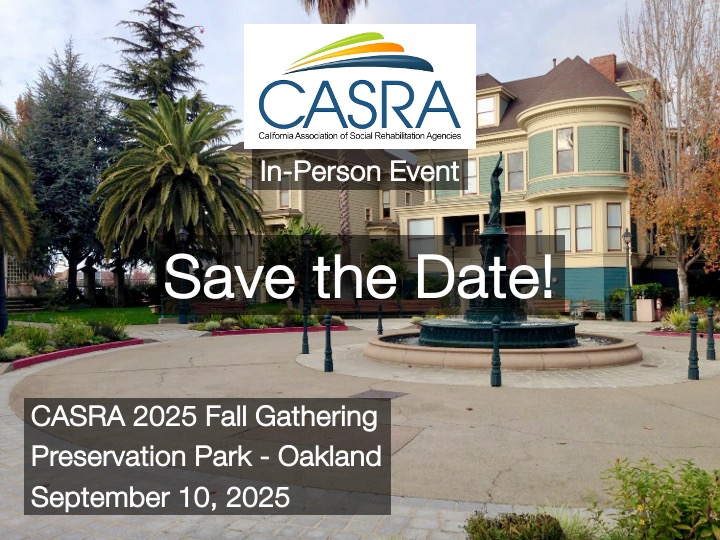
-Save the Date for the CASRA 2025 Fall Gathering 

-Gov. Newsom moves to set emergency staffing in psych hospitals

-Blue States change course on mental health policies

-The fight against involuntary commitment

-Inside LA's mental health court and the judge who wants to help

-A webinar series for clairity, understanding and information regarding Payment Reform in California

Enjoy!


If you have news you would like to share or a colleague you would like to spotlight because of the great work they do or just because they are a great person or both, let us know by contacting joe@casra.org.

Who We Are

CASRA is a statewide organization of private, not-for-profit, public benefit corporations that serve clients of the California public mental health system.

Member agencies provide a variety of services that are designed to enhance the quality of life and community participation of youth, adults and older adults living with challenging mental health issues. Read more

Member Agency Employment Opportunities and Information

Our member agencies are continually looking for new employees or volunteers to join their workforce.

To see current openings and find out additional information about CASRA Member Agencies, please click below.

CASRA Agency Learning Opportunities

A benefit of membership in CASRA is receiving four hours of training for your staff. For more information, please contact joe@casra.org


If you are a CASRA member agency and would like to advertise your learning opportunity, training or event for the benefit of other CASRA member agencies, please contact us at events@casra.org.
There are a few guidelines:
-You are a CASRA Member Agency
-Your event is free of charge
and, as a reminder the Newsletter is published on the 1st and 3rd Thursdays of the month

CASRA Member Agency Support Groups

CASRA facilitates a number of support groups for people working at CASRA member agencies. The support groups provide people working in similar roles opportunities to share experiences, information, and challenges. They meet monthly for approximantely one hour. for more information contact the person listed for each group.

Social Rehabilitation Facilities (SRF)
Meets: First Tuesday of the month at 1 PM

Human Resources
Meets: First Thursday of the month at 11 AM

EmploymentVocational Rehabilitation Services
Meets: First Thursday of the month at 3 PM

For information regarding any of the above groups contact:
Chad Costello, chad@casra.org

Wellness Services (Well Talk)
The Wellness Services support group is now online. For more info contact Joe Ruiz, joe@casra.org

Contact Us

The California Association of Social Rehabilitation Agencies

Mailing Address:
3350 E. 7th Street, #509
Long Beach, CA 90804

Email: casra@casra.org

Phone: (562) 343-2621

To reach us: use our Contact Form
Advocacy/Policy/News

Newsom Moves To Set Emergency Staffing Rules in Psychiatric Hospitals Following Chronicle Investigation

From sfchronicle.com
By Cynthia Dizikes, April 29, 2025

Gov. Gavin Newsom is moving to impose minimum staffing requirements in California’s psychiatric hospitals in response to a Chronicle investigative series that spotlighted rampant abuse and neglect tied to understaffing in many of the locked facilities.

By deploying the state’s emergency regulations process, the Newsom administration intends to establish nurse-to-patient ratios within these hospitals, which treat tens of thousands of people experiencing mental health crises every year, according to the California Health and Human Services Agency.

The move would close a regulatory loophole detailed by the Chronicle that for decades has left psychiatric hospitals without mandated staffing minimums, despite a 1999 law requiring the state to set them. Read More


Blue States Change Course on Mental Health Policies

From Axios.com
By Caitlin Owens, April 25, 2025

Cities and states that once championed progressive approaches to mental health and drug use are continuing their yearslong course reversal, and are increasingly open to involuntary commitment.

Why it matters: The push to get people with severe mental illness help — especially those who are homeless — is a response to public backlash, but may be outpacing the availability of high-quality treatment for them.

The big picture: Writing the "blue states abandon progressive drug/mental health policies" story has begun to feel repetitive to me — this has been ongoing for years. But it continues to take different iterations, and it's worth continuing to write about until someone figures out how to solve the problem. Read More


The Fight Against Involuntary Commitment: Are Protection & Advocacy Organizations Fulfilling Their Mission?

From madinamerica.com

By Rob Wipond, April 26, 2025

Spurred on by narratives that street problems are caused by mental health issues rather than by worsening economic inequities, new bills expanding powers to involuntarily commit people have been leapfrogging each other in recent years from California and New York to Oregon, Oklahoma, Indiana and beyond. Around the country, small, underfunded organizations and scrappy volunteer groups—often brought together by peers, survivors and users of the mental health system—struggle to mount campaigns to fight back and defend civil rights.

Yet every year, tens of millions of dollars in federal funding goes to state “Protection & Advocacy” (P&A) organizations specifically for the purpose of defending the rights of people labeled with mental illnesses—and that funding is supposed to be controlled by people with lived experience.

So, is that funding being optimally used? Could P&As be doing more and better in the battles against forced psychiatric interventions? (How many people have even heard of P&As?) Read More


Inside LA’s Mental Health Court: Meth, Homelessness and the Judge Who Wants To Help

From Calmatters.org

By Joe Garcia, April 23, 2025

In a Hollywood courtroom, prosecutor and defense attorney both asserted their positions on how to best administer justice to the man appearing before them in shackled restraints. Judge Ronald Owen Kaye surveyed documents on his computer, then looked over his eyeglasses from person to person.

“We’ve got quite a lot going on here,” Kaye said that day in February. He then turned his focus squarely to the defendant. With a state-appointed psychiatrist’s evaluation now on file, the judge wanted to discuss next steps. “I’d like to hear where you stand on all this, sir. Let’s talk turkey.”

“I’m sorry, your Honor,” responded the man in earnest. “I wasn’t planning on having turkey for lunch. I was kinda hoping for tuna.” Read More


If you or someone you know is considering suicide or self-harm, there are resources available to provide free and confidential support. Call 988 or the Teen Line at 1-800-TLC-TEEN or The Trevor Project at 1-866-488-7386 for LGBTQ young people.

Trainings/Conferences and other Learning Opportunities

The Catalyst Center, in collaboration with DHCS, is hosting a series of Payment Reform Trainings designed specifically for county behavioral health departments and Medi-Cal providers. These trainings are a must-attend for anyone involved in implementing Payment Reform.

Why Attend?
-Gain clarity on Payment Reform goals and implementation strategies.
-Learn how to maximize reimbursement and streamline workflows.
-Engage in Q&A sessions with industry experts and peers.
-Ensure your organization is prepared for the changes ahead.

Training Schedule: Click on title to register
May 22, 2-4PM: Managing for Success – Explore strategies for fiscal sustainability, telehealth integration, and aligning with DHCS’ CalAIM goals.
June 26, 12-2PM: A Summary and Discussion – Wrap up the series with a comprehensive review, key takeaways, and an extensive Q&A session.

Download the Webinar Series Flyer

Final Thoughts

"If a movement
is to have an impact,
it must belong
to those who join it - 
not those who lead it."

Simon Sinek


Previous | Next