California Association of Social Rehabilitation Agencies
Newsletter | June 19, 2025
Highlights and Spotlights

Welcome to the CASRA Newsletter

In this issue:

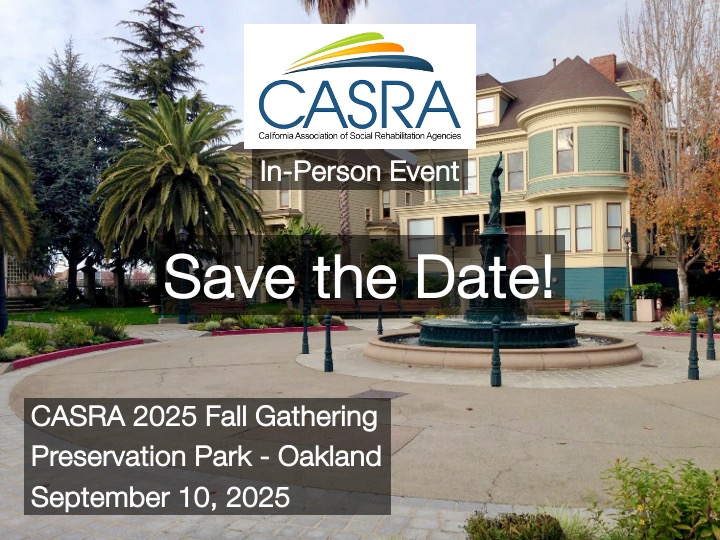
-Save the Date for the CASRA 2025 Fall Gathering 

-The CASRA Learning Library is now open!

-Reflections from a former director of the Center of Mental Health Services at SAMSHA

-A fight to reduce homeless worker burnout

-Hiring bonuses to improve California's prison mental health system

-Nature and green space can bring people together and reduce negative feelings about social isolation

Enjoy!


If you have news you would like to share or a colleague you would like to spotlight because of the great work they do or just because they are a great person or both, let us know by contacting joe@casra.org.

CASRA Learning Library

We are excited to announce that the CASRA Learning Library is now operational!

The Learning Library and its contents are free to CASRA member organizations and their staff. The Library is located in the Member Portal on the CASRA website here. More detailed instructions on how to access and use the Library can also be found on the CASRA website when logged on the Portal.

Our hope is that the Library's offerings will provide learning opportunities that will serve as part of CASRA agencies' onboarding processes for new staff, as well as be a resource of Recovery oriented values and practices for all staff. 

Access to the Learniing Library is currently limited to CASRA member agencies and their staff. We hope to expand availability in the future.

For questions and more information contact Joe Ruiz - joe@casra.org.

CASRA Member Agency Employment Opportunities and Information

Our member agencies are continually looking for new employees or volunteers to join their workforce.

To see current openings and find out additional information about CASRA Member Agencies, please click below.

CASRA Member Agency Learning Opportunities

A benefit of membership in CASRA is receiving four hours of training for your staff. For more information, please contact joe@casra.org


If you are a CASRA member agency and would like to advertise your learning opportunity, training or event for the benefit of other CASRA member agencies, please contact us at events@casra.org.
There are a few guidelines:
-You are a CASRA Member Agency
-Your event is free of charge
and, as a reminder the Newsletter is published on the 1st and 3rd Thursdays of the month

CASRA Member Agency Support Groups

CASRA facilitates a number of support groups for people working at CASRA member agencies. The support groups provide people working in similar roles opportunities to share experiences, information, and challenges. They meet monthly for approximantely one hour. for more information contact the person listed for each group.

Social Rehabilitation Facilities (SRF)
Meets: First Tuesday of the month at 1 PM

Human Resources
Meets: First Thursday of the month at 11 AM

EmploymentVocational Rehabilitation Services
Meets: First Thursday of the month at 3 PM

For information regarding any of the above groups contact:
Chad Costello, chad@casra.org

Wellness Services (Well Talk)
The Wellness Services support group is now online. For more info contact Joe Ruiz, joe@casra.org

Who We Are

CASRA is a statewide organization of private, not-for-profit, public benefit corporations that serve clients of the California public mental health system.

Member agencies provide a variety of services that are designed to enhance the quality of life and community participation of youth, adults and older adults living with challenging mental health issues. Read more

Contact Us

The California Association of Social Rehabilitation Agencies

Mailing Address:
3350 E. 7th Street, #509
Long Beach, CA 90804

Email: casra@casra.org

Phone: (562) 343-2621

To reach us: use our Contact Form
Advocacy/Policy/News

“Progress Only Occurs when People Make Demands”: Paolo del Vecchio Reflects on a Life of Federal Service, and His Fears and Hopes for the Future

From madinamerica.com
By Leah Harris, June 4, 2025

Paulo del Vecchio is a person in long-term recovery from mental health and addictions, who has been a leader in the peer recovery movement for 40 years. He recently completed a 30-year career at the U.S. Department of Health and Human Services, Substance Abuse and Mental Health Services Administration, where he served in multiple roles including the director of the Center for Mental Health Services and the founding director of the Office of Recovery.

Paolo is now an independent advocate, working to advance recovery-oriented policies and practices on national and international levels.

In this interview, he speaks with Mad in America’s Leah Harris about his roots as a housing justice activist to his decades of public service at SAMHSA, what worries him most about mental health in today’s America, and where he sees hope in the recovery movement that he helped create. Read More


The Fight To Reduce Homeless Service Worker Burnout in Grueling Industry

From latimes.com
By Andrew Khouri, June 10, 2025

Josh Hoffman sat before a room of aspiring homeless service workers and talked about why it’s important not to get discouraged.

To make his point, the veteran in the field recalled a story of a woman with mental health issues who repeatedly refused to move into a new building because birds in the neighborhood told her it wasn’t safe.

As a result, she remained on the street, but a couple of years later things changed. Hoffman said his team received a call from another organization saying the woman was now housed and was willing to follow through with the application process because she had already done it several times with them and felt comfortable.

“If we had never gotten that call we would have figured ... our work with her hadn’t really had an impact on her life, but it did,” said Hoffman, now director of homeless services at the Little Tokyo Service Center. Read More


$20K Bonuses Among Latest Moves To Improve California’s Prison Mental Health System

From kffhealthnews.org
By Don Thompson, June 9, 2025

After decades of unsuccessful efforts to improve California prison conditions ruled unconstitutional and blamed for record-high suicides, advocates and a federal judge are betting that bonuses and better work accommodations will finally be enough to attract and keep the mental health providers needed to treat prisoners.

The funds come from nearly $200 million in federal fines imposed because of California’s lack of progress in hiring sufficient mental health staff. They are being used for hiring and retention bonuses, including an extra $20,000 for psychologists and psychiatric social workers — roles with the highest vacancy rates — and $5,000 boosts for psychiatrists and recreational therapists.

“I think it’s important to point out that this is the money that the state saved by not hiring people for these positions,” said Michael Bien, an attorney representing the roughly one-third of California prisoners with serious mental illness in a class action lawsuit. “And we know that not hiring caused suffering, harm, and even death.” Read More


Do You Live in a ‘Lonelygenic Environment’? Being in Nature May Help.

Researchers Say Nature and Green Space Can Bring People Together and Reduce Negative Feelings About Social Isolation.

From washingtonpost.com
By Meeri Kim, June 17, 2025

Loneliness has become a global public health concern. Countries including the United Kingdom and Japan have appointed “ministers of loneliness” to help tackle the problem. In the United States, then-Surgeon General Vivek H. Murthy issued a public health advisory on loneliness, stating that the risk for premature death from loneliness is akin to smoking up to 15 cigarettes a day.

The adverse health outcomes linked to loneliness, including anxiety and depression and a greater risk of heart disease and dementia, are many and well-documented. However, finding effective solutions has been a challenge. It’s unclear whether person-based interventions like cognitive behavioral therapy or social skills training actually help.

What if, instead of trying to “fix” the individual, strategies focused on shaping the environment in a way that facilitates social connection? Read More


If you or someone you know is considering suicide or self-harm, there are resources available to provide free and confidential support. Call 988 or the Teen Line at 1-800-TLC-TEEN or The Trevor Project at 1-866-488-7386 for LGBTQ young people.

Trainings/Conferences and other Learning Opportunities

Final Thoughts

In recognition of Juneteenth...

“Struggle is a never ending process. Freedom is never really won; you earn it and win it in every generation.” 

Coretta Scott King


Previous | Next