California Association of Social Rehabilitation Agencies
Newsletter | July 3, 2025
Highlights and Spotlights

Welcome to the CASRA Newsletter

In this issue:

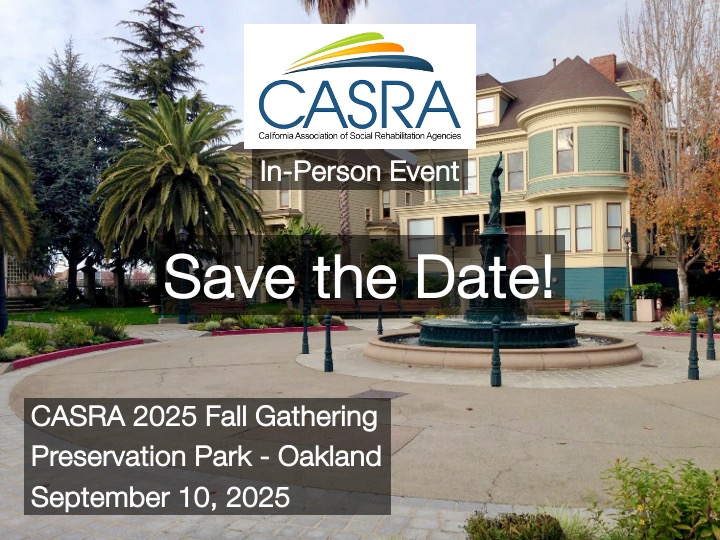
-Save the Date for the CASRA 2025 Fall Gathering 

-The CASRA Learning Library is now open!

-Building a consensus on user-defined mental health recovery

-From patient to paycheck: out of the system and into the workforce

-A report on reducing arrest and jailing people with mental illness, including those with intersectional identities

-Administration to end crisis hotline for LGBTQ+ youth. A CA city has options for those is need

Enjoy!


If you have news you would like to share or a colleague you would like to spotlight because of the great work they do or just because they are a great person or both, let us know by contacting joe@casra.org.

CASRA Learning Library

We are excited to announce that the CASRA Learning Library is now operational!

The Learning Library and its contents are free to CASRA member organizations and their staff. The Library is located in the Member Portal on the CASRA website here. More detailed instructions on how to access and use the Library can also be found on the CASRA website when logged on the Portal.

Our hope is that the Library's offerings will provide learning opportunities that will serve as part of CASRA agencies' onboarding processes for new staff, as well as be a resource of Recovery oriented values and practices for all staff. 

Access to the Learning Library is currently limited to CASRA member agencies and their staff. We hope to expand availability in the future.

For questions and more information contact Joe Ruiz - joe@casra.org.

CASRA Member Agency Employment Opportunities and Information

Our member agencies are continually looking for new employees or volunteers to join their workforce.

To see current openings and find out additional information about CASRA Member Agencies, please click below.

CASRA Member Agency Learning Opportunities

A benefit of membership in CASRA is receiving four hours of training for your staff. For more information, please contact joe@casra.org


If you are a CASRA member agency and would like to advertise your learning opportunity, training or event for the benefit of other CASRA member agencies, please contact us at events@casra.org.
There are a few guidelines:
-You are a CASRA Member Agency
-Your event is free of charge
and, as a reminder the Newsletter is published on the 1st and 3rd Thursdays of the month

CASRA Member Agency Support Groups

CASRA facilitates a number of support groups for people working at CASRA member agencies. The support groups provide people working in similar roles opportunities to share experiences, information, and challenges. They meet monthly for approximantely one hour. for more information contact the person listed for each group.

Social Rehabilitation Facilities (SRF)
Meets: First Tuesday of the month at 1 PM

Human Resources
Meets: First Thursday of the month at 11 AM

EmploymentVocational Rehabilitation Services
Meets: First Thursday of the month at 3 PM

For information regarding any of the above groups contact:
Chad Costello, chad@casra.org

Wellness Services (Well Talk)
The Wellness Services support group is now online. For more info contact Joe Ruiz, joe@casra.org

Who We Are

CASRA is a statewide organization of private, not-for-profit, public benefit corporations that serve clients of the California public mental health system.

Member agencies provide a variety of services that are designed to enhance the quality of life and community participation of youth, adults and older adults living with challenging mental health issues. Read more

Contact Us

The California Association of Social Rehabilitation Agencies

Mailing Address:
3350 E. 7th Street, #509
Long Beach, CA 90804

Email: casra@casra.org

Phone: (562) 343-2621

To reach us: use our Contact Form
Advocacy/Policy/News

Global Study Builds Consensus on User-Defined Mental Health Recovery

Mental Health Professionals Unite Around User-Centered Definitions of Recovery—Emphasizing Agency, Empowerment, and Inclusion Over Symptom Reduction.

From madinamerica.com
By Ally Riddle, June 26, 2025

As the demand for recovery-oriented mental health services grows, so does the need for a shared understanding of what “recovery” truly means.

A new study published in Social Science & Medicine represents one of the first international efforts to establish consensus among mental health professionals about the core components of recovery. Their goal is to investigate whether professionals align with the definitions developed by users and survivors, and to identify the key elements that should shape recovery-oriented services.

Within the psy-disciplines, recovery has often been narrowly defined in clinical terms, focused on symptom reduction and functional improvement. In contrast, personal recovery, grounded in service user and survivor movements, emphasizes agency, meaning, and quality of life. This misalignment can lead to practices that fail to meet the diverse needs of service users. 

Read More


From Patient to Paycheck: Out of the System and into the Workforce

From cpr.bu.edu
By Len Statham, MS, CPRP, June 20, 2025

No one grows up dreaming of being poor or permanently dependent on public benefits. Yet, for too many people with psychiatric disabilities, that becomes their reality – not because of a lack of ability or ambition, but because the system designed to support them often makes it harder for them to break free. This article is about changing that story – about helping people from patient to paycheck, from being defined by a diagnosis to being empowered by purpose.

For individuals navigating the mental health system, public benefits such as SSI or SSDI are often a necessary starting point – but, over time, what begins as a safety net can become a ceiling. The fear of losing vital supports – such as healthcare, housing, and stability – can keep people locked out of the workforce. The irony is clear: the very systems meant to support recovery often discourage progress, and while benefits may meet some short-term needs, they do little to build long-term hope. To play off the Mastercard commercial: 

Read More


Reducing Arrest and Jailing of People with Mental Health Disabilities, Including Those with Intersectional Identities

From safetyandjusticechallenge.org
By Judge David L. Bazelon Center for Mental Health Law, June 23, 2025

This paper will explore the intersectional identities of people with mental health disabilities involved with the criminal legal system, including the added challenges they face, and the community-based, person-centered solutions that better serve us all, including by embracing, rather than stigmatizing, diversity. Throughout, we provide examples of initiatives that communities across the country, including the MacArthur Foundation’s Safety + Justice Challenge network cities and counties, are undertaking to better serve a diverse population and reduce their exposure to law enforcement and incarceration. These community initiatives are not only more effective and humane than using criminal enforcement mechanisms to address mental health challenges, but also help communities comply with civil rights laws and federal protections for people with mental health disabilities by providing services in the most integrated setting and ensuring everyone has an equal opportunity to benefit from public programs and services. 

Read the Report


The Current Administration Will End Crisis Hotline for LGBTQ+ Youth. But L.A. Has Options for Those in Need

From latimes.com
By Karen Garcia, June 26, 2025

A national hotline will no longer provide services specifically for LGBTQ+ youths in crisis. The administration is ending that support next month.

The 988 Suicide and Crisis Lifeline has counselors for anyone in emotional distress or contemplating suicide but also has connected LGBTQ+ youth with specially trained counselors. Research has shown this population experiences significantly higher rates of suicidal ideation. But that specialized service will end July 17.

The Substance Abuse and Mental Health Services Administration, which funds the 988 hotline, said in a statement that callers would no longer have the option to “press 3” for LGBTQ+-specific services. The agency said it would not “silo LGB+ youth services” but rather focus on serving all who are seeking help.

Read More


If you or someone you know is considering suicide or self-harm, there are resources available to provide free and confidential support. Call 988 or the Teen Line at 1-800-TLC-TEEN or The Trevor Project at 1-866-488-7386 for LGBTQ young people.

Trainings/Conferences and other Learning Opportunities

Final Thoughts

It is not light that we need, but fire; it is not the gentle shower, but thunder. We need the storm, the whirlwind, and the earthquake.

Frederick Douglass


Previous | Next