California Association of Social Rehabilitation Agencies
Newsletter | August 7, 2025
Highlights and Spotlights

Welcome to the CASRA Newsletter

In this issue:

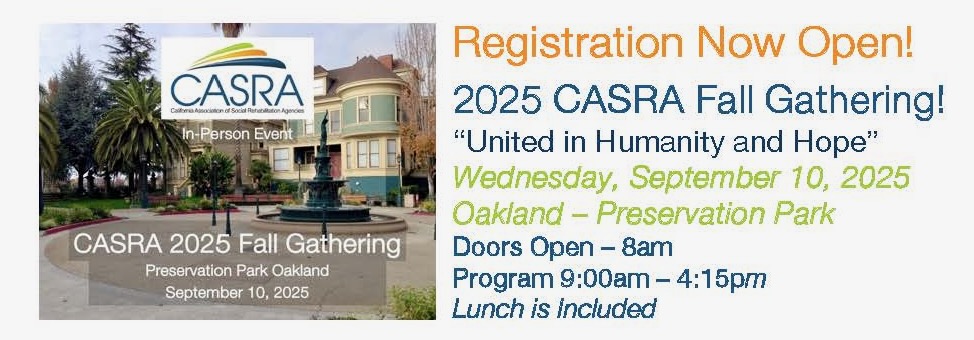
-Registration for the Fall Gathering is now open!
-Rapid defunding of vital programs and rolling back progressive programs
-Challenges maintaining CA's behavioral workforce
-How connection to culture is saving Sacramento's Native American youth from suicide
-The CASRA Learning Library is now open!

Enjoy!


If you have news you would like to share or a colleague you would like to spotlight because of the great work they do or just because they are a great person or both, let us know by contacting joe@casra.org.

CASRA Learning Library

We are excited to announce that the CASRA Learning Library is now operational!

The Learning Library and its contents are free to CASRA member organizations and their staff. The Library is located in the Member Portal on the CASRA website here. More detailed instructions on how to access and use the Library can also be found on the CASRA website when logged on the Portal.

Our hope is that the Library's offerings will provide learning opportunities that will serve as part of CASRA agencies' onboarding processes for new staff, as well as be a resource of Recovery oriented values and practices for all staff. 

Access to the Learning Library is currently limited to CASRA member agencies and their staff. We hope to expand availability in the future.

For questions and more information contact Joe Ruiz - joe@casra.org.

CASRA Member Agency Employment Opportunities and Information

Our member agencies are continually looking for new employees or volunteers to join their workforce.

To see current openings and find out additional information about CASRA Member Agencies, please click below.

CASRA Member Agency Learning Opportunities

A benefit of membership in CASRA is receiving four hours of training for your staff. For more information, please contact joe@casra.org


If you are a CASRA member agency and would like to advertise your learning opportunity, training or event for the benefit of other CASRA member agencies, please contact us at events@casra.org.
There are a few guidelines:
-You are a CASRA Member Agency
-Your event is free of charge
and, as a reminder the Newsletter is published on the 1st and 3rd Thursdays of the month

Who We Are

CASRA is a statewide organization of private, not-for-profit, public benefit corporations that serve clients of the California public mental health system.

Member agencies provide a variety of services that are designed to enhance the quality of life and community participation of youth, adults and older adults living with challenging mental health issues. Read more

Contact Us

The California Association of Social Rehabilitation Agencies

Mailing Address:
3350 E. 7th Street, #509
Long Beach, CA 90804

Email: casra@casra.org

Phone: (562) 343-2621

To reach us: use our Contact Form
Advocacy/Policy/News

For More Information and to Register, CLICK HERE


America is Legislating a Return to the Asylum, One Policy at a Time

Federal and State Policymakers Across the Partisan Divide Are Rapidly Defunding Vital Programs and Rolling Back Progressive Policies and Enshrined Rights Protections

From madinamerica.com
By Lean Harris, July 26, 2025

The budget reconciliation megabill signed by Trump on July 4 is among the latest in a series of federal and state policy choices this year that will have devastating impacts on poor people, disabled people, and people who use drugs across the US. These decisions have in some instances forced voluntary community-based services and peer respites to reduce hours or shutter altogether, as they simultaneously threaten existing disability rights protections like the 1999 Supreme Court Olmstead vs. LC decision that requires states to eliminate the unnecessary segregation of disabled people in institutions.

This year, activists have had to respond to a dizzying array of upheavals and losses—from sudden, arbitrary funding cuts that threw state public health systems into disarray, to the announced dismantling of the Substance Abuse and Mental Health Administration (SAMHSA), to the proposed defunding of Protection and Advocacy for Individuals with Mental Illness (PAIMI) program, to a new attempted repeal of the Institutions for Mental Diseases (IMD) exclusion that was created as part of Medicaid in 1965 to disincentivize institutional care. Taken together, these decisions funnel public dollars away from community support and rights protection, and accelerate the drumbeat towards reinstitutionalization.

And on July 24, President Trump issued an executive order that seeks to put “homeless individuals into long-term institutional settings” with those seen as mentally ill candidates for this long-term lockup. Given that state laws govern forced treatment standards, this executive order would need to rely on bullying tactics from the President and his administration, related to the withdrawing of federal funds to states that failed to comply with this call for long-term incarceration of the mentally ill, to enforce this executive order. Even so, it serves, at the moment, as evidence of the hostile political landscape today toward policies and initiatives that people with lived experience have fought for in the past decades. Read More


As California’s Behavioral Health Workforce Buckles, Help Is Years Away

From kffhealthnews.org
By Christine Mai-Duc, August 6, 2025

This spring, the Good News Rescue Mission in Redding which runs the only emergency homeless shelter in Shasta County, received a game-changing $17.8 million state grant to build a 75-bed residential treatment facility in a region where thousands struggle with drug and alcohol addiction.

Now comes the hard part — recruiting and hiring 10 certified substance use counselors and about a dozen other staff members to work at the new site, about 170 miles north of the state capital.

“Ask anyone trying to get staff and it’s difficult,” said Justin Wandro, the mission’s head of development. “Try to get people who are willing to work in very intense, very difficult environments. It’s hard.” Read More


How Culture Saves Sacramento’s Native American Youth From Suicide

From sacbee.com
By Emma Hall, August 6, 2025

Jordan Burkart learned pain at a young age.

She was placed in foster care at just three days old after Child Protective Services learned her parents were using drugs, she said. Though she was later adopted, she boomeranged between her birth and adoptive parents during her early childhood.

Life was especially chaotic with her biological parents. Burkart, now 22 and an incoming senior at Sacramento State, recalled that they used to steal her shoes and hang them over electrical wires signaling to a dealer that they wanted to buy drugs. She didn’t feel safe.

Burkart said she started feeling depressed and anxious in social situations as a preteen. At her lowest points in high school, she admitted she had suicidal thoughts.

“I felt like nobody loved me,” Burkart said. “I just felt like I was not good enough.” Read More


If you or someone you know is considering suicide or self-harm, there are resources available to provide free and confidential support. Call 988 or the Teen Line at 1-800-TLC-TEEN or The Trevor Project at 1-866-488-7386 for LGBTQ young people.

Trainings/Conferences and other Learning Opportunities

For more information and to register, CLICK HERE

Final Thoughts

Do the right thing. It will gratify some people and astonish the rest.

Mark Twain


Previous | Next