California Association of Social Rehabilitation Agencies
Newsletter | April 2, 2026
Highlights and Spotlights

Welcome to the CASRA Newsletter

In this issue:

-A new strategy to help prevent homelessness

-How Psych Rehab brings community into care

-A new lifeline to help inmates trainsition to life outside the bars

-Introvert, Extrovert, or "Outrovert"

Enjoy!


If you have news you would like to share or a colleague you would like to spotlight because of the great work they do or just because they are a great person or both, let us know by contacting joe@casra.org.

CASRA Member Agency Learning Opportunities

A benefit of membership in CASRA is receiving four hours of training for your staff. For more information, please contact joe@casra.org


If you are a CASRA member agency and would like to advertise your learning opportunity, training or event for the benefit of other CASRA member agencies, please contact us at events@casra.org.
There are a few guidelines:
-You are a CASRA Member Agency
-Your event is free of charge
and, as a reminder the Newsletter is published on the 1st and 3rd Thursdays of the month

Photo Gallery

A Photo Gallery now resides on the EVENTS page of the CASRA website and currently consists of albums of the 2024 Spring and the 2025 Fall CASRA Gatherings. We plan on adding more albums in the future.

If you have photos of your agency's events you would like to share with other CASRA members, contact joe@casra.org.

To view the current albums in the Photo Gallery, CLICK HERE.

CASRA Learning Library

The  CASRA Learning Library and its contents are free to CASRA member organizations and their staff. The Library is located in the Member Portal on the CASRA website here. More detailed instructions on how to access and use the Library can also be found on the CASRA website when logged on the Portal.

Our hope is that the Library's offerings will provide learning opportunities that will serve as part of CASRA agencies' onboarding processes for new staff, as well as be a resource of Recovery oriented values and practices for all staff. 

Access to the Learning Library is currently limited to CASRA member agencies and their staff. We hope to expand availability in the future.

For questions and more information contact Joe Ruiz - joe@casra.org.

CASRA Member Agency Employment Opportunities and Information

Our member agencies are continually looking for new employees or volunteers to join their workforce.

To see current openings and find out additional information about CASRA Member Agencies, please click below.

CASRA Member Agency Support Groups

CASRA facilitates a number of support groups for people working at CASRA member agencies. The support groups provide people working in similar roles opportunities to share experiences, information, and challenges. They meet monthly for approximantely one hour. for more information contact the person listed for each group.

Social Rehabilitation Facilities (SRF)
Meets: First Tuesday of the month at 1 PM

Human Resources
Meets: First Thursday of the month at 11 AM

Employment/Vocational Rehabilitation Services
Meets: First Thursday of the month at 3 PM

For information regarding any of the above groups contact:
Chad Costello, chad@casra.org

Wellness Services (Well Talk)
The Wellness Services support group is now online. For more info contact Joe Ruiz, joe@casra.org

Who We Are

CASRA is a statewide organization of private, not-for-profit, public benefit corporations that serve clients of the California public mental health system.

Member agencies provide a variety of services that are designed to enhance the quality of life and community participation of youth, adults and older adults living with challenging mental health issues. Read more

Contact Us

The California Association of Social Rehabilitation Agencies

Mailing Address:
3350 E. 7th Street, #509
Long Beach, CA 90804

Email: casra@casra.org

Phone: (562) 343-2621

To reach us: use our Contact Form
Advocacy/Policy/News

A New Homelessness Strategy Is Sweeping California

Homelessness Prevention Shows Promising Results in California, as Advocates Push To Spread It Statewide and Nationally

From calmatters.org
By Marisa Kendall, March 25, 2026

Maybe the way out of California’s homelessness crisis is to prevent it in the first place, rather than focusing only on people who have already lost their housing.

That’s the thinking behind a program in Santa Clara County — and others like it around the state — that has gained traction and will soon test its strategy beyond California.

These prevention programs have found that with a payment of several thousand dollars, aid organizations can head off someone’s homelessness. That both prevents the trauma that comes with losing a home, and saves the state or local government the potentially tens of thousands of dollars it takes to help someone after they become homeless.

The Santa Clara County program by nonprofit Destination: Home recently inspired the launch of 10 more pilot projects throughout the country, marking the first large-scale, multi-state test of this strategy. If it works in those test counties, advocates will push for a nationwide program.  Read More


What’s the Equivalent of a Wheelchair for a Person With Schizophrenia? How Psychiatric Rehabilitation Brings Community Into Care

From theconversation.com
By Adrienne Lapidos, Elzabeth Thomas, Kristen Abraham, March 18, 2026

Imagine your dream is to get a job at the local library. You have a love for people and for books. You also have schizophrenia, a psychiatric disability that makes life in the community more challenging.

You often have extreme psychological experiences. When you leave your apartment, you hear voices that tell you it’s not safe, and you feel scared. People seem to keep their distance from you. You feel lonely sometimes.

Most of the people you spend time with are mental health staff members, who provide medications and psychological therapies to make the voices and paranoia less intense. Their treatment philosophy is based on the belief that by reducing the symptoms, working at the library might be possible for you someday.

But what if they have it backward? What if waiting for your symptoms to get better means waiting too long, or even forever? Read More


A New Lifeline Helps Inmates Transition to Life Outside the Bars

Medicaid Is Now Paying for Health Care in Jails and Prisons, Helping Smooth Inmates’ Return to the Community. Corrections and Law Enforcement Officials Say They’re All for It.

From nytimes.com
By Ted Alcorn, March 13, 2026

When Jon Desantis was released after a six months stint in jail last September, he had lost many of the moorings of a stable life.

He could not go back to his apartment, because the girlfriend he had shared it with before his conviction on assault charges had cut ties with him. The construction company where he’d worked for years told him his position had been filled. And though it was nearly paid off, creditors repossessed his F-250 pickup truck, with storage for tools that he had built himself.

Born and raised in San Jose, Mr. Desantis, 37, might have called acquaintances for help, but that carried its own risks. “It’s very easy for me to fall into situations or run into people that I have known for a very long time that aren’t necessarily doing the things that they should be doing,” he said.

Instead, he got a vital assist from an unexpected place: California’s Medicaid program. Read More


Are You an Otrovert? What to Know About the New Personality Type

From Time.com
By Jamie Friedlander Serrano, March 13, 2026

Perhaps you've never wanted to join an intramural basketball league. Maybe you don't identify with a political party or religion. There's a new personality type that might speak to those who don't feel the need to belong to groups: otroverts.

Dr. Rami Kaminski, a psychiatrist in New York City, developed the idea of the otrovert after he spent years observing patients who seemed to share a similar set of traits. He coined the term—otro, coming from the Latin root for “other,” and vert, the Latin verb for “turn toward”—in his 2025 book The Gift of Not Belonging: How Outsiders Thrive in a World of Joiners.

Otroverts are people who embody the quality of not wanting to belong to a group, says Kaminski, who identifies as an otrovert. They’re not social outcasts, though. “Unlike those with relational disorders, otroverts are empathetic and friendly, yet struggle to truly belong in social groups, despite no apparent behavioral distinctions from well-adjusted individuals,” Kaminski writes in his book. Read More


If you or someone you know is considering suicide or self-harm, there are resources available to provide free and confidential support. Call 988 or the Teen Line at 1-800-TLC-TEEN or The Trevor Project at 1-866-488-7386 for LGBTQ young people.

Trainings/Conferences and other Learning Opportunities

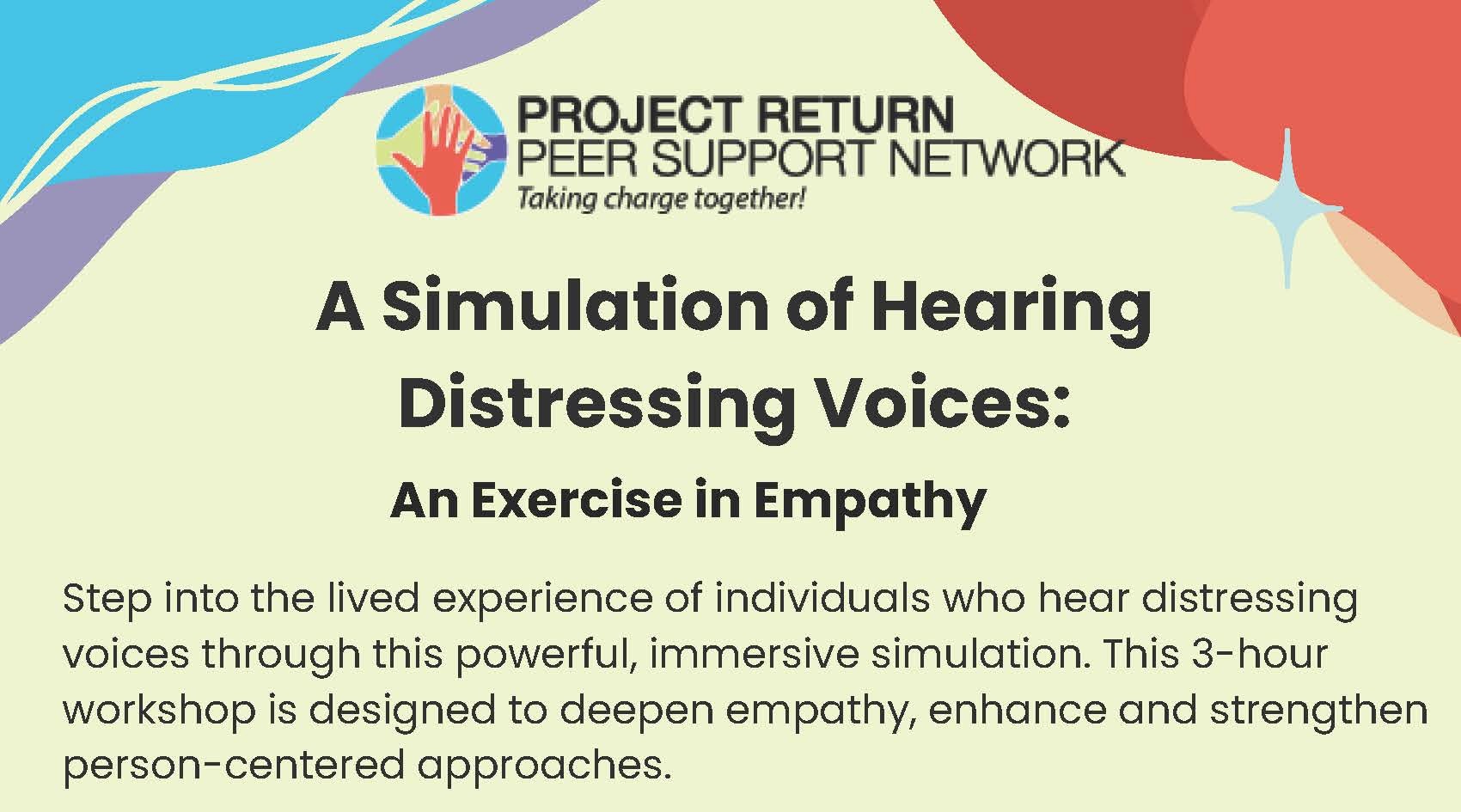
Project Return Peer Support Network (PRPSN) Provides certified WRAP training

CASRA member agency Project Return Peer Support Network (PRPSN) is now a licensed Wellness Recovery Action Plan (WRAP). PRPSN's Training Institute is now a leading provider of WRAP Seminars across the West Coast, helping individuals and organizations build wellness tools that foster hope, personal responsibility, and empowerment.

 For more information or to schedule a WRAP Seminar, please contact PRPSN's Training Coordinator, Gustavo Limas at glimas@prpsn.org.


Learn More

Final Thoughts

The horizon of victory seems to be lost in the thick fog, still there is no skepticism in their hearts. They will see the light at the end of their journey soon.

Larry Itliong
Farmworker Labor Organizer
10/25/1913 - 2/8/1977


Previous | Next